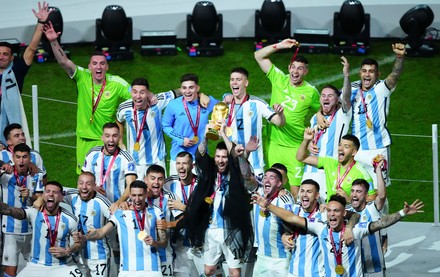
Argentina manager Lionel Scaloni revealed that his captain Lionel Messi is on course to earn his 200th international cap in the reigning champions’ opening World Cup 2026 match against Algeria, a milestone that would place the Paris Saint-Germain forward in rarefied company among the small number of outfield players who have reached such a landmark in the history of the game.
The significance of the moment was not lost on Scaloni, who spoke about it with visible emotion in his pre-match press conference. “The whole planet is watching,” he said, capturing both the scale of the global interest in Messi’s performance and the weight of expectation that Argentina carry into the tournament as the defending champions seeking to become the first side in the modern era to retain the World Cup title.
Messi himself has approached the milestone with characteristic understatement, deflecting attention toward the team’s collective goals and expressing his primary focus as Argentina’s performance rather than individual records. Those who know him well describe a player whose relationship with personal statistics is entirely instrumental — numbers matter only insofar as they reflect meaningful achievement for the team.
Algeria, Argentina’s opponents in the opener, arrive as a team that has been building steadily under their coach and with a generation of players coming into their prime. The North African side has a point to prove on the world stage and will not be intimidated by the occasion or by the calibre of the opposition. Their tactical approach, likely to involve organised defensive work and dangerous transitions, will test Argentina’s ability to break down disciplined opponents.
Argentina’s squad, despite the retirement of several key figures from the 2022 World Cup winning generation, remains formidable. The blend of experience from that historic triumph in Qatar and fresh talent emerging from Argentine club football provides Scaloni with quality and options across all positions. The question, as with any defending champion, is whether the collective belief and organisational coherence that produces championship victories can be maintained and reproduced across another full tournament cycle.
The 200-cap milestone places Messi in discussion with the handful of outfield players who have represented their countries most often in international football history. It reflects not just longevity but the consistent excellence that has made him indispensable to Argentina across different eras and under different coaching regimes. That he has arrived at a second World Cup as the reigning champion, with the opportunity to achieve something no player has done before, gives the milestone its particular resonance.
Fans who have followed his career from his teenage debut to this point describe a player whose evolution has been as much about leadership and collective contribution as individual brilliance. The young Messi who arrived on the international scene with breathtaking individual skill has matured into a captain whose presence elevates the confidence and performance of everyone around him. That transformation, as much as any statistical record, defines the significance of his career.
Whatever the outcome of the tournament, the World Cup 2026 will almost certainly represent Messi’s final chapter at the event that has most defined his legacy. The football world is watching with a mixture of hope and bittersweet awareness that these opportunities to see him at the highest level are now numbered, each one precious in ways that may only become fully apparent when they are no longer available.