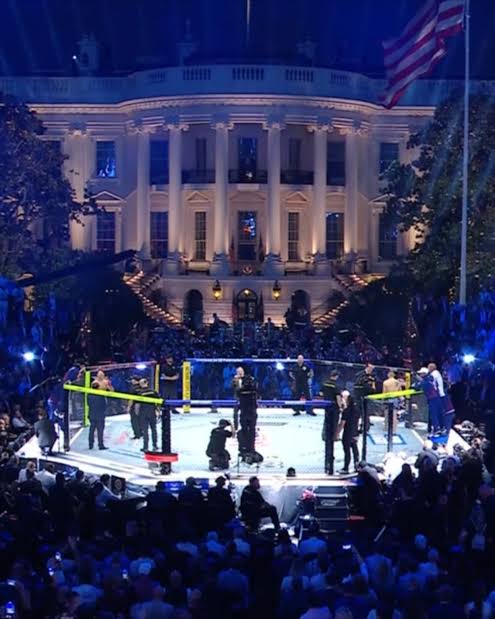
UFC president Dana White declared that the White House fight night would not be repeated after an evening of cage fighting on the South Lawn of the presidential residence descended into controversy when politically charged commentary targeting former First Lady Michelle Obama was broadcast to the assembled crowd and a global pay-per-view audience, creating a reputational incident that overshadowed what had been intended as a showcase of American fighting sports and presidential hospitality.
The event, which had been promoted heavily as an unprecedented spectacle combining championship mixed martial arts with the prestige of the White House as a venue, attracted a wealthy and well-connected crowd alongside the fighters and their teams. In the main event, Justin Gaethje stunned Ilia Topuria with a performance that demonstrated the technical quality that made the fight genuinely worth watching independent of the surrounding political context.
The incident involving Michelle Obama arose during commentary segments that White, speaking in the aftermath, described as crossing lines he had not authorised and did not sanction. The specific remarks, which circulated widely on social media and were condemned by Democratic politicians and many sports commentators as gratuitous and offensive, became the dominant story of the event within hours of its conclusion, relegating the actual athletic competition to secondary interest.
White’s “never again” declaration was interpreted by observers as reflecting both genuine discomfort with the political dimension of the event and a pragmatic calculation about the commercial risks of associating the UFC brand too closely with partisan political controversy. The UFC has worked assiduously to expand its audience globally and across demographic groups, and an event perceived as a vehicle for political attacks risks alienating fans who follow the sport for its athletic content.
Eric Trump, who was among the organisers of the event, denied allegations of misconduct that emerged in its aftermath, insisting that the evening had achieved its intended purpose of showcasing the sport and the president’s relationship with American fighting culture. His defence stood in some tension with White’s distancing from aspects of the event’s execution.
The broader questions raised by the event about the relationship between sport, entertainment, and political spectacle are not new — presidents have long sought associations with popular sporting figures and events — but the explicit use of a championship sporting event as a platform for partisan political messaging represented a more aggressive version of this dynamic than precedent suggests is appropriate.
Fighters who competed in the evening’s bouts spoke carefully about the political dimensions of the event, most preferring to focus on their athletic performances rather than the controversies surrounding the venue and commentary. For professional fighters, appearing on a major platform regardless of its political context can be career-defining; navigating the reputational implications of that context is a calculation each athlete made individually.
The legacy of the White House fight night is likely to be debated for some time — whether it represents a normalisation of the use of sporting spectacle for political purposes that should concern those who value sport’s relative independence from partisan politics, or simply an unusual episode that will be filed as a curiosity of a particular moment in American political culture.