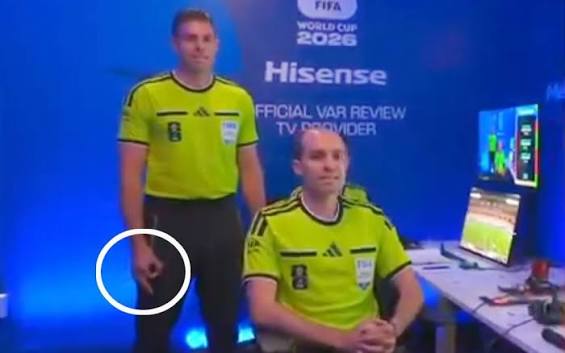
Australian video assistant referee Shaun Evans issued a detailed public statement denying that a hand gesture he made during a World Cup 2026 match was intentional or carried any meaningful significance, describing it as “an involuntary, subconscious twitch” of which he was entirely unaware. FIFA, after reviewing the footage and conducting its own inquiry, confirmed that there had been no breach of its code of conduct.
The gesture, captured on broadcast footage and circulated on social media where it was interpreted by some viewers as potentially resembling a white supremacist symbol, created an immediate storm that threatened to overshadow the football action and forced FIFA’s disciplinary machinery into rapid action. The speed and ferocity with which the incident spread online illustrated both the scrutiny under which every participant in a global event of this scale operates and the dangers of social media amplification of ambiguous moments.
Evans, who has worked as a referee and VAR official in Australian football for many years and has an unblemished professional record, expressed dismay that his reputation had been called into question. He welcomed the opportunity to address the matter directly and provided FIFA with detailed testimony about the circumstances of the gesture, including his physical state during the match and the absence of any intention to communicate a message of any kind.
The incident raised broader questions about the psychological and physical demands placed on match officials at a tournament of this scale. VAR officials work in isolated, high-pressure environments, monitoring multiple simultaneous video feeds and making time-critical decisions that are then subject to global scrutiny. The conditions are demanding, and involuntary physical tics and movements are not uncommon among people working under sustained high pressure.
FIFA used the incident to reaffirm its zero-tolerance policy on discrimination of any kind, including gestures, symbols, or conduct associated with racist or supremacist ideologies. The organisation took the initial complaint seriously and conducted its investigation rapidly, which officials described as evidence that the governance structures for handling such incidents are functioning as intended.
The refereeing community responded to the outcome with measured relief and a degree of frustration. Senior officials and referee associations in several countries issued statements supporting Evans and expressing concern about the culture of instant online condemnation that can destroy reputations before investigations are complete. The principle of due process, they argued, applies to match officials as much as to players and coaches.
Social media platforms faced criticism for the speed with which unverified interpretations of the footage spread. Fact-checking services were among the voices urging caution in the immediate aftermath, but their measured assessments competed poorly with the outrage-generating posts that drove engagement. The episode became a small but illustrative case study in the challenges of managing reputation in an age of real-time global scrutiny.
Evans will continue in his VAR role for the remainder of the tournament. FIFA’s confirmation of his clearance should, in theory, draw a line under the matter, though the nature of social media means that the original allegation will remain searchable and associated with his name regardless of the subsequent exoneration. For officials at future international tournaments, the incident will serve as a reminder of the permanent scrutiny under which they operate and the importance of maintaining complete awareness of their every movement in front of broadcast cameras.