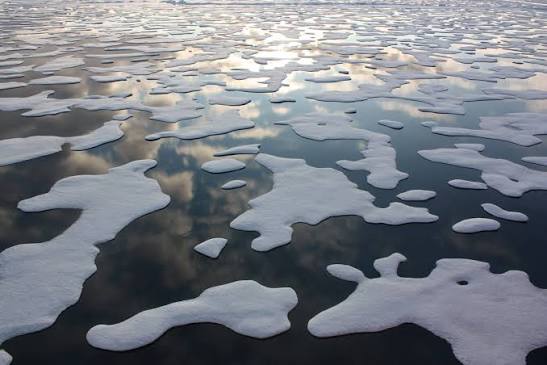
The Arctic sea ice extent has fallen to its second lowest level since satellite measurements began in the late 1970s, with monitoring data from the National Snow and Ice Data Center confirming that the annual minimum recorded this summer represents a continuation of a decades-long decline that researchers increasingly describe as irreversible within any human planning horizon. The measurements, compiled from multiple satellite platforms, show that the ice cap has retreated well beyond the boundaries that characterised the Arctic environment for thousands of years, exposing vast stretches of open water where thick multi-year ice once persisted year-round.
The implications of this contraction extend far beyond the immediate loss of frozen habitat for species such as polar bears, walruses, and several seal populations whose reproductive cycles are tightly synchronised with the availability of sea ice platforms. Scientists monitoring the broader Earth system have long warned of feedback mechanisms that accelerate warming once the ice cover begins to thin: open ocean water absorbs solar radiation at a rate roughly seven times greater than reflective ice, creating a self-reinforcing loop that adds thermal energy to an already-warming system. The albedo effect, as this phenomenon is known, is now considered one of the primary amplifying mechanisms behind the disproportionate pace of warming observed in the Arctic compared with lower latitudes.
Ocean circulation patterns that have governed the distribution of heat across the northern hemisphere for millennia are also responding to the changing thermal gradient between the Arctic and the mid-latitudes. Research published in leading geophysical journals has identified a weakening of the jet stream as a probable consequence of reduced temperature differential between the poles and the equatorial belt, a development linked to the increasing frequency of persistent weather anomalies — prolonged heatwaves, extended drought conditions, and the unusual blocking patterns that have contributed to extreme precipitation events in parts of Europe and North America. The precise mechanisms connecting Arctic sea ice loss to mid-latitude weather remain a subject of vigorous scientific debate, but the broad outlines of the relationship are no longer seriously contested within the atmospheric science community.
Indigenous communities across the circumpolar north have been documenting the changes through traditional ecological knowledge systems that in some cases predate instrumental records by generations. Hunters and fishers from Alaska to Siberia have described the unpredictability of ice conditions, the appearance of unfamiliar species in waters that were once reliably frozen, and the erosion of coastal settlements whose permafrost foundations are thawing beneath them. Their testimony has increasingly been incorporated into scientific assessments as researchers recognise that continuous human observation of a landscape across multiple generations can yield qualitative insights that satellite data alone cannot capture.
The geopolitical dimension of Arctic transformation has attracted growing attention from defence analysts and international relations scholars. The emergence of navigable shipping routes across waters that were previously impassable for much of the year has intensified strategic competition among Arctic and near-Arctic states, with competing territorial claims over the extended continental shelf and the resource extraction rights that accompany them now the subject of sustained diplomatic engagement. The prospect of commercially viable Arctic shipping lanes connecting Atlantic and Pacific markets has been projected by economic analysts to reshape freight economics in ways that could alter the competitive position of existing canal routes and the nations whose revenues depend on transit fees.
What remains absent from the international response, environmental advocates argue, is any mechanism capable of matching the pace of the changes being measured with the urgency required to alter their trajectory. The commitments made under successive climate agreements have consistently fallen short of the emissions reductions that climate modelling identifies as necessary to stabilise the Arctic system, and the gap between stated ambition and verified action has been a persistent feature of the international climate negotiating process. For the scientists who have spent careers monitoring the ice, the latest measurements represent not a surprise but a confirmation — one more data point in a series whose direction has been evident for decades.