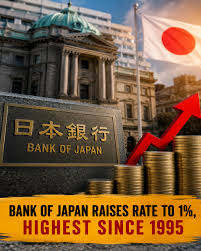
The Bank of Japan raised its benchmark interest rate to one percent this week in a decision that marks the most aggressive step yet in the central bank’s gradual withdrawal from decades of ultra-loose monetary policy, a shift with potentially profound consequences for Japanese financial markets, the global carry trade, and the broader international economy.
The decision, taken after a closely watched policy meeting, was driven by inflation data that has remained persistently above the central bank’s two percent target for longer than policymakers initially anticipated. Japan, which spent much of the past three decades fighting deflation with zero and negative interest rates and massive asset purchase programmes, now finds itself managing the unfamiliar challenge of sustained inflation — a development that has required a fundamental rethink of monetary strategy.
Governor Kazuo Ueda, who has navigated the rate-raising cycle with careful communication designed to avoid destabilising financial markets, emphasised that the pace of future increases would remain gradual and data-dependent. The bank is acutely aware that moving too quickly could tip Japan’s fragile economic recovery into recession, while moving too slowly risks allowing inflation expectations to become entrenched in a way that would require more aggressive action later.
Japanese government bond yields rose in response to the announcement, reflecting market expectations of further rate increases ahead. The yen also strengthened slightly, a development that provides some relief to Japanese consumers facing higher import costs but creates challenges for the country’s large export-oriented manufacturing sector, whose competitive position depends significantly on currency levels.
The implications for global financial markets extend well beyond Japan’s borders. For years, Japan’s near-zero interest rates made the yen an attractive funding currency for the “carry trade” — the practice of borrowing cheaply in yen and investing in higher-yielding assets elsewhere. As Japanese rates rise, the differential that makes this trade profitable narrows, potentially triggering a reversal of positions that could create volatility in markets from emerging economies to US Treasuries.
Japanese households, many of whom hold the bulk of their savings in low-yielding bank deposits, stand to benefit from higher rates on their savings. But the same households carry significant mortgage debt, much of it on variable rate terms, and will face higher debt service costs as rates rise. The distributional effects of monetary tightening will play out differently across different segments of the population.
The corporate sector faces its own adjustment. Japanese companies that borrowed heavily during the period of near-zero rates to fund investment, share buybacks, and acquisitions will see their financing costs increase. For many of Japan’s large conglomerates, this is a manageable adjustment; for smaller, more leveraged businesses, the impact could be more significant.
Economists studying Japan’s experience see its current situation as a significant natural experiment in the unwinding of unconventional monetary policy. No major economy has attempted to normalise monetary conditions after as extended a period of unconventional measures as Japan has deployed. The lessons from how this process unfolds will be closely studied by central bankers in economies that deployed similar tools during and after the COVID-19 pandemic.
For ordinary Japanese people, the most immediate effect of higher interest rates is the possibility that the purchasing power erosion of recent years may gradually moderate. The combination of rising wages — which Japanese companies have been delivering in response to labour market tightness and government pressure — and eventually lower inflation could improve living standards in ways that would genuinely shift public sentiment about the direction of economic policy.