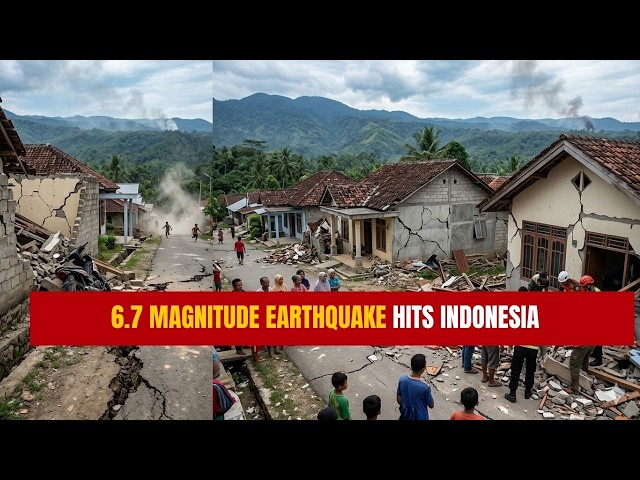
A powerful earthquake measuring 6.7 on the Richter scale struck a populated region of Indonesia, sending residents fleeing from buildings and triggering emergency response protocols across the affected area. Initial reports indicated structural damage to residential and commercial buildings, with authorities mobilising search and rescue teams and establishing evacuation centres for displaced residents.
Indonesia sits on the Pacific Ring of Fire, one of the most seismically active zones on the planet, and experiences thousands of earthquakes annually, ranging from barely perceptible tremors to catastrophic events. The country’s history of devastating earthquakes — including the 2004 Indian Ocean tsunami and the 2018 Lombok and Palu earthquakes — has driven significant investment in early warning systems, building codes, and community preparedness programmes over the past two decades.
The Indonesian National Board for Disaster Management coordinated the emergency response, deploying personnel and resources to the most severely affected communities. Helicopters were dispatched to conduct aerial assessment of damage in areas where road access was disrupted by the earthquake’s effects on infrastructure. Medical teams were pre-positioned at locations identified as likely casualties reception points based on population density and structural vulnerability maps.
Communications in the immediate aftermath of a significant earthquake are often disrupted as cell towers are damaged and power outages affect telecommunications infrastructure. Emergency services relied on backup communication systems and coordination through the national emergency management framework to maintain situational awareness in the critical first hours after the event.
The Philippines earthquake disaster drills conducted earlier this year — which studies suggest reduced casualties when a major earthquake subsequently struck — have been cited by Indonesian emergency management officials as a model for the kind of preparedness investment that saves lives. Indonesia has been expanding its own community drill programme, and the question of how well-prepared the affected communities were in the current event will form part of the post-event assessment.
Building standards in Indonesia have improved significantly since previous major earthquakes exposed the vulnerability of traditional and informal construction to seismic forces. However, enforcement of modern building codes remains uneven, particularly in rural areas and rapidly growing urban peripheries where informal construction is common and regulatory oversight is limited. The pattern of damage in this earthquake will provide data about the effectiveness of building code improvements.
International partners including Japan, which has deep expertise in earthquake preparedness from its own seismic history, and the United States have offered technical assistance through established disaster response cooperation frameworks. Indonesia has generally managed its own disaster responses but welcomes technical expertise in areas like search and rescue methodology and medical response.
For the communities most directly affected, the immediate priority is accounting for missing persons, securing temporary shelter for those whose homes are uninhabitable, and meeting basic needs including food, water, and medical care. The longer recovery process — rebuilding damaged homes and infrastructure, addressing the psychological impacts of the event, and restoring economic activity — will require sustained attention and resources over many months.