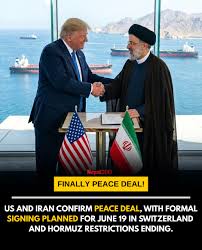
A preliminary agreement between the United States and Iran to end months of direct military confrontation edged closer to a formal signing ceremony this week, with American and Iranian officials confirming that core terms had been agreed upon — even as Republican senators and Middle East analysts raised pointed questions about the deal’s durability and enforcement mechanisms.
Vice President JD Vance described the agreement as “about a page and a half” in length and acknowledged that many of the technical details, including arrangements for sanctions relief, nuclear programme constraints, and the reopening of the Strait of Hormuz to international shipping, would need to be worked out in subsequent negotiations. That candid admission did little to reassure sceptics who argued that an agreement without enforceable specifics was little more than a ceasefire announcement dressed up as a diplomatic achievement.
On Capitol Hill, several senior Republican senators broke with the White House to express doubt about whether the deal adequately addressed Iran’s nuclear ambitions. The concern, voiced most forcefully by members of the Senate Foreign Relations and Armed Services committees, centred on whether Tehran had genuinely committed to abandoning its uranium enrichment programme or had merely agreed to pause it temporarily in exchange for economic relief.
The Iranian government’s public messaging was carefully calibrated, with senior officials confirming the broad outlines of an agreement while insisting that the country retained its sovereign right to a civilian nuclear programme. Supreme Leader Ali Khamenei had not made a public statement as of the latest reports, fuelling speculation about the internal politics surrounding the deal within Iran’s complex power structure.
Israel’s reaction was a study in barely contained fury. Prime Minister Benjamin Netanyahu, who had repeatedly insisted that Iran’s nuclear infrastructure must be physically destroyed rather than diplomatically constrained, issued a statement that stopped short of outright rejection while making clear his view that the agreement left Israel’s fundamental security concerns unaddressed. Netanyahu’s political position has been complicated by the deal, which places him in the uncomfortable position of openly disagreeing with a US president whose support he depends on.
The Gulf states, while more measured in their public responses, were understood to be pressing for strong verification mechanisms and a clear linkage between Iranian compliance with nuclear constraints and the pace of sanctions relief. The Abraham Accords signatories and Saudi Arabia, which has its own complex relationship with both the US and Iran, have significant equities in the outcome of this diplomatic process.
Energy markets responded to news of the deal with a sharp drop in oil prices, reflecting trader expectations that Iranian crude could soon return to global markets in significant volumes. The price movement was welcomed by consuming nations facing elevated energy costs but prompted concern in OPEC+ capitals, where governments had structured their budgets around assumptions of continued high oil revenue.
Diplomatic historians noted that the history of US-Iran agreements is not encouraging. The 2015 JCPOA, which was hailed at the time as a transformative diplomatic achievement, was abandoned by the United States three years later. Whether this administration’s deal can be structured in a way that survives future political cycles, particularly given the partisan divisions evident on Capitol Hill, is the central question that will determine its long-term significance.
For the tens of thousands of people on both sides who died or were displaced during the recent months of conflict, the agreement represents the possibility of an end to immediate violence. Whether it represents genuine progress toward a stable and peaceful regional order is a question that will be answered only by what comes next.