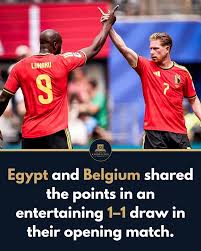
Belgium needed a Romelu Lukaku substitute appearance to salvage a 1-1 draw against Egypt in their World Cup 2026 group opener, with the veteran striker’s immediate impact after coming off the bench providing the moment of individual quality that rescued a result that had been threatening to slip away entirely in the closing stages.
Egypt had taken a deserved lead through a powerful first-half performance that exposed vulnerabilities in the Belgian defensive structure that the Red Devils’ coaching team will need to address urgently before their next match. The African side, buoyed by an atmospheric support presence in the stadium, played with a directness and physical intensity that repeatedly troubled Belgium’s build-up and created genuine danger on the counter-attack.
Lukaku’s introduction changed the match’s dynamic almost immediately. Whatever reservations the coaching staff may have had about his minutes load — the striker has battled injury concerns throughout his career and management of his fitness remains a constant consideration — the decision was vindicated by the moment his head connected with a cross and redirected it past the Egyptian goalkeeper via a deflection that gave the keeper no chance of recovery.
The Belgian camp was careful in its post-match messaging, acknowledging that the performance was well below the standard they require to progress deep into the tournament while avoiding the kind of public self-criticism that can damage team morale. The result, a draw that preserves their qualification path, was described as an acceptable outcome given the circumstances, though privately the coaching staff will be deeply concerned by what they witnessed.
Egypt’s performance has been celebrated as vindication of an approach that their coach has built over several years — tactical discipline, physical organisation, and the exploitation of transitional moments. Their players showed an understanding of their roles and responsibilities that suggests a well-drilled outfit capable of causing further problems for opponents who underestimate them.
The Egyptian goalscorer, whose finish was precise and technically accomplished under considerable physical pressure, was the subject of particular praise from neutral observers. He has been developing into a player of genuine international quality at club level and this performance on the world stage will significantly raise his profile among the major European clubs that will be watching the tournament with recruitment in mind.
The broader picture for Group H remains complex and fascinating. Belgium’s reputation and squad quality make them favourites to progress, but they will need to demonstrate considerably more consistency than they showed in this opener. Egypt’s performance will have encouraged Uruguay and Saudi Arabia’s coaching teams that they face opponents with genuine vulnerabilities.
World Cup group stages produce their most interesting dynamics when the presumed hierarchy of teams is genuinely uncertain, and this group has the ingredients for exactly that scenario. Each match from here carries enormous consequence, and the pressure of navigating that consequence will test the mental and physical resources of all four squads equally.
For Lukaku personally, the substitute appearance and the immediate decisive contribution provides ammunition against those who suggest his best years are behind him. He has said repeatedly that he remains motivated at the highest level and that his physical condition is better than at any point in recent seasons. Whether he starts in Belgium’s next match will be one of the tournament’s interesting team selection questions.