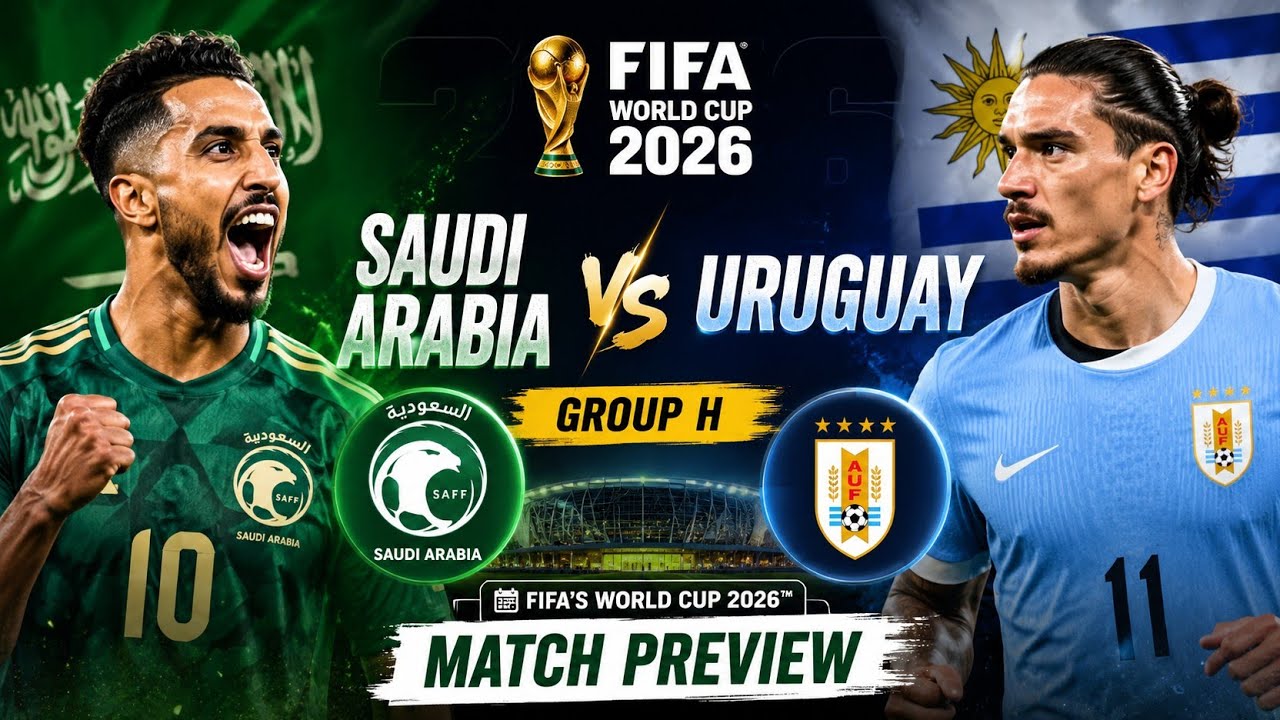
Uruguay survived a nervy second half to secure a 1-1 draw against Saudi Arabia in their World Cup 2026 group stage opener, with Ronald Araújo’s late header denying the Saudis a result that would have sent shockwaves through tournament predictions and given the Asian side back-to-back World Cup upsets to celebrate.
Saudi Arabia came into the match with belief rooted in their stunning victory over Argentina at the 2022 World Cup in Qatar, a result that remains one of the great upsets in the tournament’s history. That they nearly replicated something similar against another South American giant suggests their rise on the world stage is no fluke but a product of sustained investment and tactical sophistication that demands serious respect.
The match followed a pattern familiar in knockout-stage football even at group level. Saudi Arabia pressed Uruguay relentlessly in the opening exchanges, disrupting their rhythm and forcing mistakes in areas of the pitch where the South Americans are typically assured. Their goal came from precisely this pressure — a turnover in midfield that led to a swift transition and a finish that gave the Uruguayan goalkeeper no chance.
Uruguay’s response was measured and experienced. This is a squad with a deep reservoir of international tournament pedigree, players who have contested finals and semi-finals and understand how to manage the emotional challenge of conceding first without panicking. Their equaliser came from exactly the kind of composed build-up play and clinical finishing that defines South American football at its best, though the Saudis pushed hard for a winner that never arrived.
Araújo’s intervention to rescue the draw illustrated his value as a leader in moments of maximum pressure. The Barcelona defender read the situation with the intelligence of a player who has played in Champions League knockout rounds, throwing himself into an aerial challenge at the far post that he had no guarantee of winning and connecting perfectly. His celebration combined relief, determination, and the particular intensity of a player who understands exactly what a goal has prevented.
The tactical approaches of both coaches will be scrutinised carefully before their next matches. Uruguay’s midfield was given too much space in the first half, allowing Saudi Arabia’s energetic pressing to disrupt supply lines to the forwards. Adjustments were made at half-time that improved their control without fully resolving the problem, suggesting there is work still to do.
Saudi Arabia’s coach spoke after the match with quiet pride about his team’s performance, rejecting suggestions that losing the lead in the closing minutes represented a failure. A draw against Uruguay is a respectable result that keeps their qualification hopes very much alive, and the way they played for long periods of the match demonstrated levels of technical quality that continue to confound those who categorise Asian football as purely defensive and reactive.
The group standings after this result and the Iran-New Zealand draw leave all four teams in contention for the two qualifying places, setting up a series of matches in which the consequences of every result will be immediately felt. It is precisely this kind of competitive tension that makes the group stage of a World Cup such compelling viewing and such demanding football for those playing it.
For Uruguayan supporters, the relief of the late equaliser will mix with awareness that their team needs to perform more consistently across ninety minutes if they are to challenge seriously in the knockout rounds. The talent is unquestionably there; maintaining the concentration and intensity that tournament football demands for the full duration of each match is the challenge that their remaining games will test.