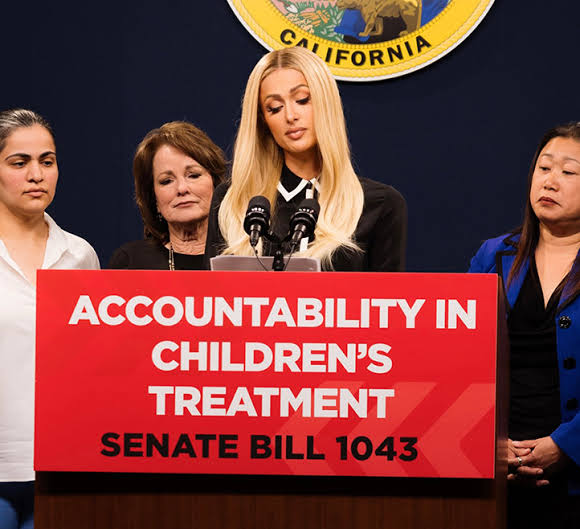
Paris Hilton returned to the Utah residential facility where she was held as a teenager in circumstances she has described as abusive, accompanying a group of survivors and their advocates in an act of solidarity designed to maintain public pressure for comprehensive reform of an industry that critics argue continues to cause serious harm to vulnerable young people in the name of therapy.
Hilton has been one of the most prominent and persistent voices in the campaign to reform the “troubled teen industry” — the collection of wilderness programmes, therapeutic boarding schools, and residential treatment facilities that have operated with minimal regulatory oversight for decades. Her documentary and advocacy work brought significant public attention to a set of practices that survivors had been documenting and protesting for years without achieving legislative traction.
The visit was not primarily a media event, though Hilton acknowledged that the public attention her presence generates is itself a tool for keeping the issue on political agendas. She spent time with individuals who had been held at the facility as teenagers and who are still processing the long-term effects of their experiences, offering solidarity and the particular understanding of someone who has shared aspects of their situation.
The legislative landscape around residential treatment facilities has shifted meaningfully in recent years, partly as a result of advocacy campaigns in which Hilton has played a central role. Several states have strengthened oversight requirements, mandatory reporting obligations, and inspection regimes for facilities working with minors. Federal legislation that would create national minimum standards has been introduced in Congress, though its progress has been slow.
Critics of the industry argue that state-level reforms, while important, are insufficient because facilities can relocate across state lines to avoid stricter regulatory environments. The absence of federal standards means that the protections available to a young person in the system depend substantially on which state they happen to be in, a patchwork that allows problematic facilities to continue operating by staying ahead of regulatory enforcement.
Hilton has framed her advocacy as a personal obligation arising from her own experiences and from the responsibility she feels toward other survivors who lack her platform and resources. She has described the difficulty of coming forward publicly about her experiences, the disbelief she initially encountered from people who found it hard to reconcile the abuse she described with the facilities’ therapeutic marketing, and the gradual building of a public narrative that others could attach their own stories to.
The young people currently in residential treatment facilities are unable to advocate publicly for themselves, a reality that makes the advocacy of survivors and allies particularly important. Their experiences will only become known if the adults they later become choose to speak, or if oversight mechanisms strong enough to detect abuse while it is occurring are put in place. The campaign is aimed at achieving both.
Hilton’s return to the Utah facility was described by her team as emotionally difficult but important, a confrontation with the physical space of a painful past in service of a present commitment to change. The symbolic power of such a return, standing in a place that once confined you and insisting that what happened there must not happen to others, is not lost on those who were present or on the wider audience following the story.