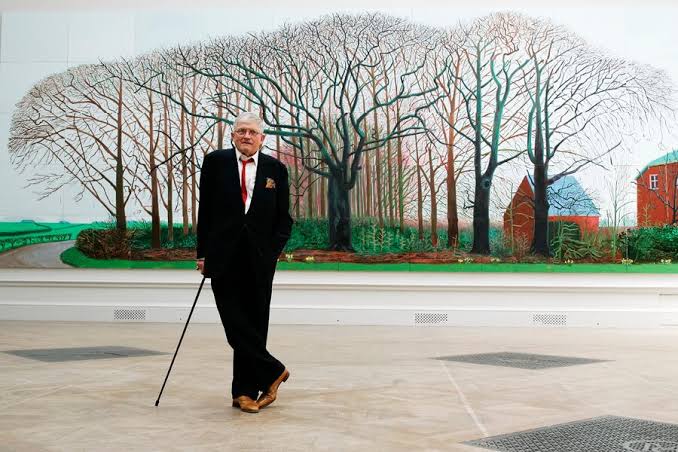
The art world has been processing the loss of David Hockney, the British painter, photographer, and print-maker whose death at the age of 88 ended one of the most prolific and consistently surprising careers in modern art history. Hockney’s work spans from the Pop Art enthusiasm of his Bradford years through the sunlit California swimming pools that made him internationally famous, to the Yorkshire landscapes he returned to in his later career and the digital paintings he produced on an iPad that proved he could still astonish with a new medium at an age when most artists have long since settled into comfortable repetition.
What distinguished Hockney throughout his career was not any single style or subject but a consistent quality of attention — a way of looking at the world that was simultaneously analytical and joyful, intellectually rigorous and sensuously alive to colour, light, and the particular pleasures of visual experience. His famous declaration that he painted what he wanted to see, not what was fashionable or critically approved, was not defiance for its own sake but a genuine statement of artistic priority.
The swimming pool paintings — particularly A Bigger Splash, which has become one of the most recognisable images in modern art — capture something specific about Los Angeles in the late 1960s and early 1970s: the leisure, the light, the slightly disquieting sense of human absence in spaces designed for pleasure. But they also demonstrate Hockney’s ability to solve formal problems that have nothing to do with California — how to paint water, how to depict the moment of explosion frozen in time, how to use flat colour to create depth and movement.
His Yorkshire landscape work, particularly the large-format multi-canvas paintings of Woldgate Woods and the spring arrival in the East Riding, showed a different Hockney but an unmistakable one. The sheer ambition of the scale, combined with a colour palette that made English countryside look almost hallucinatorily vivid, demonstrated that he had lost none of his desire to push what painting could do even as he entered his seventies.
The iPad work divided critics but fascinated many. Hockney embraced the device as a drawing tool with the enthusiasm of someone who had always been excited by new technologies — he was one of the first serious artists to embrace the fax machine as an art form, to the bemusement of the art establishment — and produced a body of work that used the medium’s specific qualities, particularly its luminous colour, in ways that no one else had quite imagined.
His influence on subsequent generations of artists is difficult to quantify but easy to recognise. The willingness to make pleasure a legitimate subject, to embrace figuration when abstraction was fashionable, to engage with photography and printmaking and performance without abandoning the central commitment to painting — these aspects of his practice gave permission to artists who needed to see that such choices were artistically defensible.
Hockney spoke in his later interviews with disarming directness about mortality, about the pleasure he still took in looking, and about his conviction that art is ultimately about the joy of seeing. His own life and work embodied that conviction completely. The world he saw, and the ways he found to share his vision of it, enriched the lives of everyone who encountered his work. That enrichment does not end with his passing.