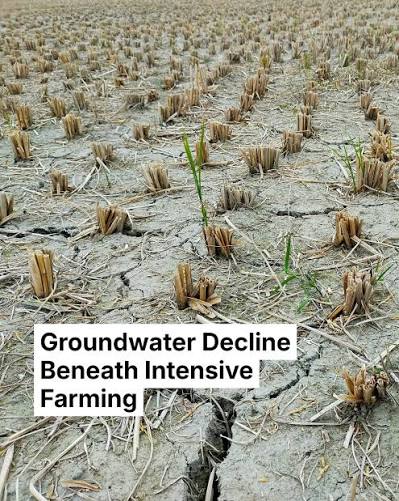
Aquifers that have taken tens of thousands of years to fill beneath the agricultural heartlands of South Asia, the American Great Plains, and North Africa are being emptied at rates that hydrologists describe as geologically instantaneous, with new satellite gravity measurements confirming that the pace of groundwater extraction has accelerated significantly over the past two decades as population growth and dietary shifts towards water-intensive food systems have combined to create a demand for freshwater that surface supplies alone cannot meet. The implications extend well beyond the immediate regions of depletion: the aquifers in question underpin food production systems that collectively feed hundreds of millions of people, and their exhaustion would necessitate agricultural transformations of a scale and speed that existing economic and governance structures are poorly equipped to manage.
The measurement techniques that have made the scale of the crisis legible to scientists and policymakers alike represent one of the more consequential advances in Earth observation technology of the past two decades. The GRACE satellite mission, which measures minute variations in Earth’s gravitational field caused by changes in the mass of water stored beneath the surface, has provided a continuous record of aquifer depletion since the early 2000s that bypasses the patchy and often unreliable network of ground-level monitoring wells that previously constituted the primary data source for hydrologists attempting to track regional water budgets. The picture it has revealed is one of consistent and in some cases accelerating loss across the world’s most agriculturally productive regions.
In the Indo-Gangetic Plain, which produces a significant share of the staple crops consumed across South Asia, groundwater levels have fallen at rates that have required farmers to deepen wells multiple times within a single generation. In the Punjab regions of both India and Pakistan, crops that were introduced during the Green Revolution of the 1960s and 1970s — most notably high-yielding varieties of rice that are not naturally suited to the semi-arid climate — consume quantities of water that substantially exceed what the annual monsoon recharges. The political economy of water pricing in both countries has historically treated groundwater as a free or heavily subsidised input, an arrangement that has encouraged extraction at rates that would be economically irrational if the full cost of depletion were reflected in agricultural price signals.
The American High Plains Aquifer, also known as the Ogallala, presents a variation on the same fundamental problem. Stretching beneath eight states from South Dakota to Texas, it supports irrigated agriculture that generates tens of billions of dollars in output annually, including a substantial portion of the United States’ wheat, corn, sorghum, and cotton production. In its southern reaches, where the aquifer is thinnest and recharge rates are lowest, the water table has fallen by more than thirty metres in some areas since intensive irrigation began in the mid-twentieth century. Unlike depleted surface reservoirs, which can refill after a wet season, many sections of the Ogallala will not meaningfully recharge within any timeframe relevant to current agricultural planning — the geological processes that replenished the aquifer occurred during wetter climatic periods that no longer obtain.
Policy responses have been complicated by the fragmented governance structures that govern groundwater access in most jurisdictions. In much of the United States, groundwater rights are managed under legal doctrines that allow landowners to extract water beneath their property without limit, creating a collective action problem in which individual farmers have strong incentives to pump as quickly as possible before neighbouring wells lower the water table further. Attempts to impose collective management regimes have met with resistance from farming communities whose livelihoods and generational investments are dependent on continued access to the resource, and whose political influence in rural states has historically been sufficient to slow or prevent regulatory reform.
The international food security dimension of aquifer depletion has received growing attention from analysts who model the cascading effects of regional agricultural collapse. The countries and regions most vulnerable to groundwater exhaustion are also, in several cases, major suppliers of staple crops to global commodity markets, meaning that a sharp contraction in their productive capacity would transmit food price shocks to importing nations that have no direct connection to the aquifers being depleted. Addressing that systemic vulnerability, researchers argue, requires treating groundwater as a shared global resource rather than a local extraction question — a conceptual shift that has proved resistant to the national and sub-national governance frameworks within which most water policy is currently made.